Residential roofing covers the whole assembly above your ceiling: the shingles, the underlayment beneath them, and the flashing that turns water away from walls and seams.
On the 1960s and 1970s ranch-style single-family homes common around Concord, that assembly usually outlasts two or three owners before it asks for anything.
Mid-century modern tract homes with pitched roofs wear much the same way. The contemporary suburban developments built in the 1990s and 2000s are now hitting their first round of end-of-life wear.
Hot, dry summers with occasional fire season winds bake the asphalt in a shingle and dry out the sealant around pipe boots. Winter rain with occasional heavy downpours finds every gap, and moderate temperature swings between seasons work nails loose.
Ask a roofer what shortens a roof's life here and you hear two answers: ultraviolet on the south slope, and water sitting at the flashing. Fixing flashing before moisture wicks into the deck is what separates a repair from a replacement.
Energy efficiency matters too. A clear ridge vent and intact attic insulation keep the deck cooler in July, and dry insulation keeps working through a wet January.
What we inspect and replace on a residential roof
- Asphalt shingles: architectural shingles outlast three-tab shingle on the south-facing slopes where summer sun hits hardest.
- Underlayment: synthetic underlayment replaces roofing felt and tar paper that have gone brittle after decades of heat.
- Ice-and-water shield: a self-adhered membrane along the eave and valley catches water that backs up behind an ice dam or a clogged gutter.
- Step flashing and counter-flashing: rebuilt wherever a roof plane meets a sidewall, which is where most of our leak calls start.
- Chimney flashing and apron flashing: re-detailed around masonry and headwalls, then hand-sealed at the lap.
- Pipe flashing and pipe boot: the rubber collar cracks first, so it gets swapped before the leak reaches your ceiling.
- Drip edge and eave: metal drip edge keeps runoff off the fascia and stops the sheathing edge from wicking.
- Ridge, ridge cap and ridge vent: a new ridge cap goes down with the field course, and we confirm the ridge vent, soffit vent and attic fan still move air.
- Valley, hip and rake: the high-wear lines that collect debris and need re-detailing, not another bead of caulk.
- Roof deck, sheathing, plywood and OSB: soft spots get cut out and replaced before any underlayment goes down.
- Truss, rafter, joist and ridge beam: checked whenever a sag, settle or buckle shows in the roofline.
- Gutter and downspout: cleaned, re-pitched or replaced so water leaves the rooftop instead of sitting against the fascia.
- Skylight and dormer: resealed and reflashed where they cut through the roof plane, since both are common water-entry points.
- Fascia, soffit and rafter tails: rot here usually means the drip edge failed years ago and nobody noticed.
Materials we install, and where each one fits
- Architectural shingle and three-tab shingle are the workhorses, and GAF, Owens Corning and CertainTeed all make lines we install regularly.
- Wood shake and cedar shake suit older homes, though they need more upkeep and a straight conversation about fire season before summer.
- Slate, clay tile and concrete tile carry real weight, so we check the purlin, batten and counterbatten framing before quoting.
- Metal panel, standing-seam panel and corrugated panel shed heat well and resist wind uplift better than most shingles.
- Membrane systems, including TPO, EPDM and PVC membrane, handle low-slope sections and the parapets, scuppers and coping on flat or mansard roofs.
- Built-up roof and modified bitumen still make sense on some flat areas, laid hot with a torch or cold with adhesive and finished with a coating.
- Tar, pitch and bitumen show up in older homes, and we note what is there so the next crew is not guessing.
- Snow guard and roof anchor points are worth adding on steep pitches for winter safety and future access.
Warning signs a roof inspection usually turns up
- Granule loss: shingle surfaces shed grit into the gutter while the asphalt underneath dries and oxidizes.
- Curling and missing shingles: wind uplift peels the sealant strip apart and the next storm finishes the job.
- Blistering, alligatoring and delamination on flat roofing, usually over ponding water or trapped moisture.
- Rot and decay in the fascia, soffit or decking, which often means water has been seeping for more than one season.
- Peeling paint, flaking caulk and spalling masonry around the chimney, a sign the flashing has already failed.
- Corrosion on an exposed fastener or a rusted screw head, which points to a nail that was overdriven or under-sealed.
- Sag or settle in the roofline, which is structural and needs a look at the rafters before anything else.
- Hail damage, a bruised shingle or a dent in the metal, which an insurance adjuster will want documented with photos.
How a residential roofing job runs, step by step
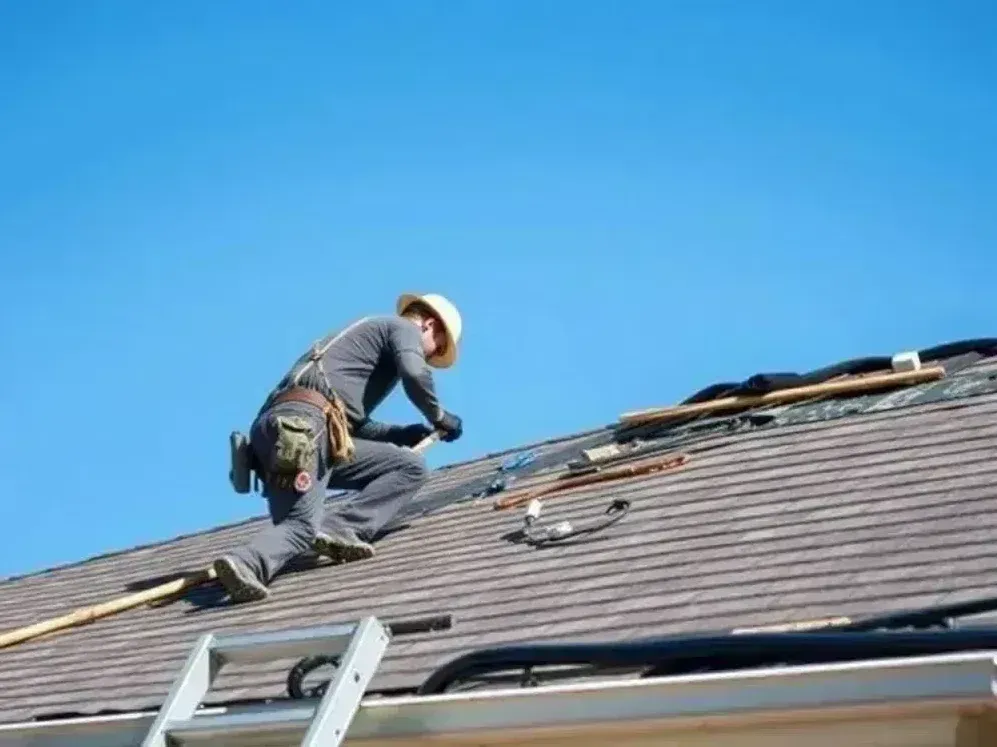
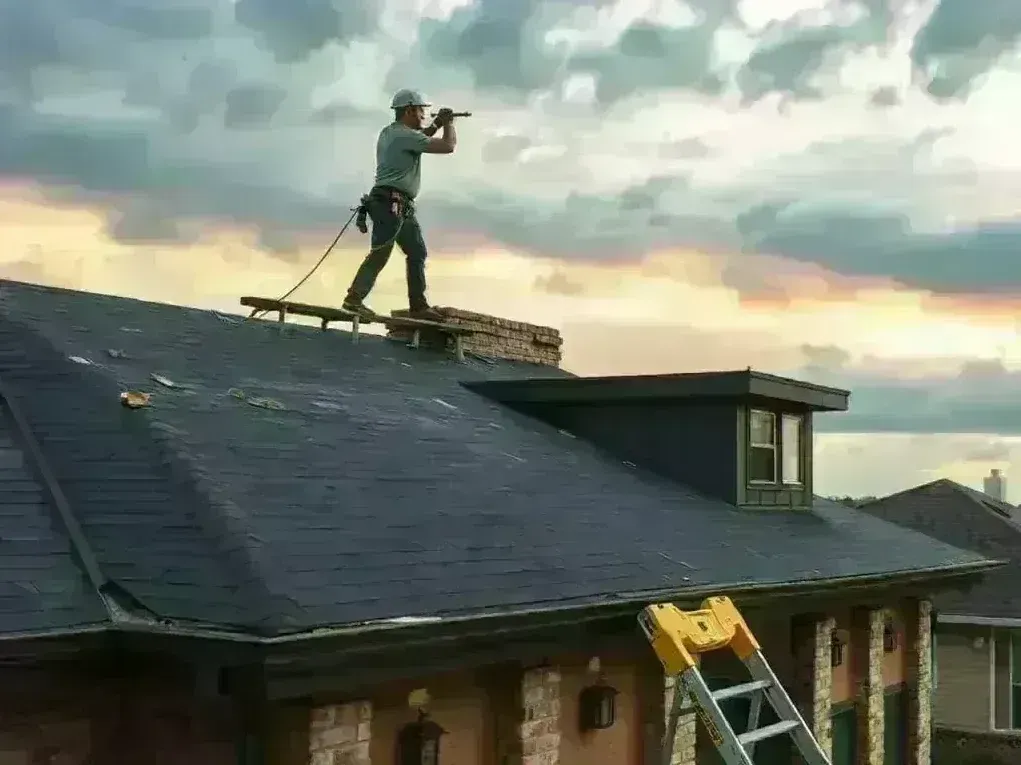
- Roof inspection: we walk the rooftop with a ladder and safety harness, setting up scaffold where the pitch is steep, and check pitch, granule loss, flashing condition and deck condition.
- Roof estimate: you get a line-item estimate listing every repair, so nothing appears as a surprise later.
- Permits and building code: we pull what the city requires and build to code on ventilation, fastening and underlayment.
- Tear-off or overlay: full tear-off is the default on a failing roof, while a recover is only worth it when the substrate is sound.
- Deck repair: damaged sheathing, decking and substrate come out with a pry bar and roofing shovel, and framing between truss and rafter gets sistered where it has moved.
- Underlayment and ice-and-water shield: rolled over a clean, dry deck, with the attic vapor barrier checked from below.
- Flashing and drip edge: step flashing, counter-flashing, apron flashing and boot flashing are hand-sealed at every transition.
- Field course: starter course first, then staggered courses set with ring-shank nails from a nail gun fed by our air compressor.
- Ridge cap and ventilation: ridge cap, ridge vent and soffit vent get closed out, and a roofing square keeps the courses honest at the rake and verge.
- Cleanup: dumpster and debris hauled off, a magnet sweep for stray nails, then a walkthrough and your warranty paperwork.
Roof shapes change the labor. A simple gable or hip roof goes fast; a mansard or gambrel with a low-slope skirt, a canopy or awning over an entry, or a wide overhang all add flashing detail.
Weatherproofing is a system, not a tube of caulk. We use mastic and roof cement sparingly, at small transitions where a full flashing rebuild is not yet warranted.
Cost comes down to square footage, roof pitch, how many layers have to come off, and how much decking has rotted. Most repairs finish in a day, while a full replacement on a typical ranch home runs two to four days.
Call East Bay Roofers at +19257224916 for a free roof inspection and a written estimate you can compare line by line.